Research projects

Every paper from the KAIST MLP Lab with its own project page, newest first.

2026

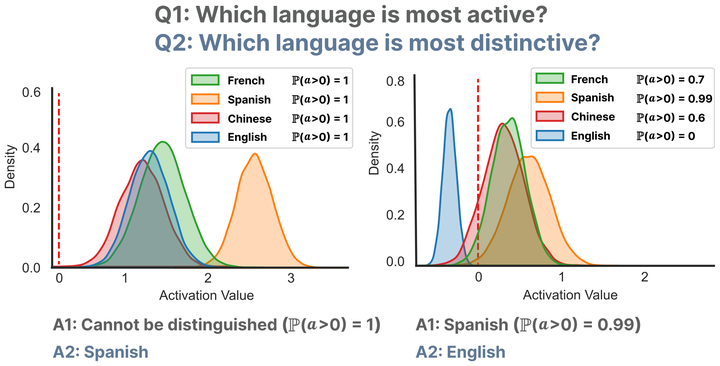
Two activation-density plots for one neuron across French, Spanish, Chinese, and English, showing that activation probability alone cannot tell which language is most distinctive.

EMNLP 2026

Distribution-aware Language Neuron Identification in Multilingual Large Language Models

Minjun Kim, Inho Won, Junghun Yuk, Dongyeon Kim, Jihyo Kim, KyungTae Lim

We identify language-specific neurons in multilingual LLMs by comparing full per-language activation distributions (including negative values) with pairwise overlap coefficients, yielding up to 4.9x higher on-target language damage per neuron than entropy-based selection while preserving off-target languages.

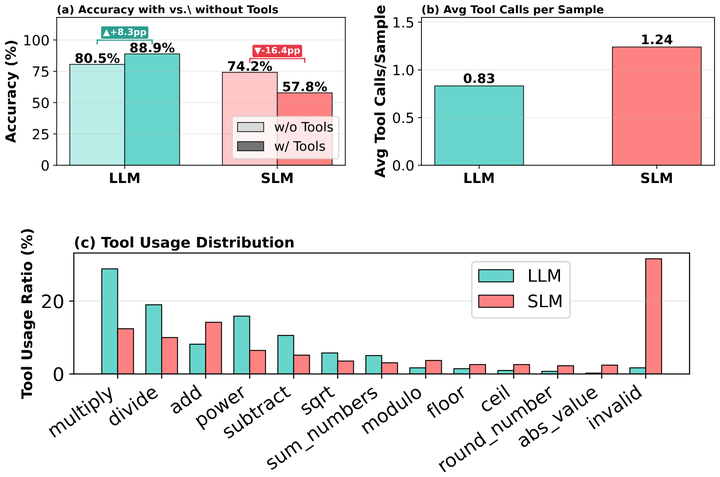
Bar charts comparing tool use of Qwen3-235B and Qwen3-8B: tools raise LLM accuracy from 80.5% to 88.9% but lower SLM accuracy from 74.2% to 57.8%, while the SLM makes more tool calls per sample (1.24 vs. 0.83).

EMNLP 2026

MENTOR: Reinforcement Learning via Flexible Teacher-Optimized Rewards for Tool-Use Distillation

ChangSu Choi, Hoyun Song, Dongyeon Kim, Minkyung Cho, WooHyeon Jung, SunJin Park, NohHyeob Bae, Seona Yu, KyungTae Lim

MENTOR is an on-policy reinforcement learning framework for tool-use distillation from LLMs into small language models that rewards using the teacher's set of tools rather than copying its exact trajectory. On Qwen3-8B it raises math accuracy to 48.26% (SFT: 41.47%) and improves out-of-domain BFCL-v4 and RAG performance.

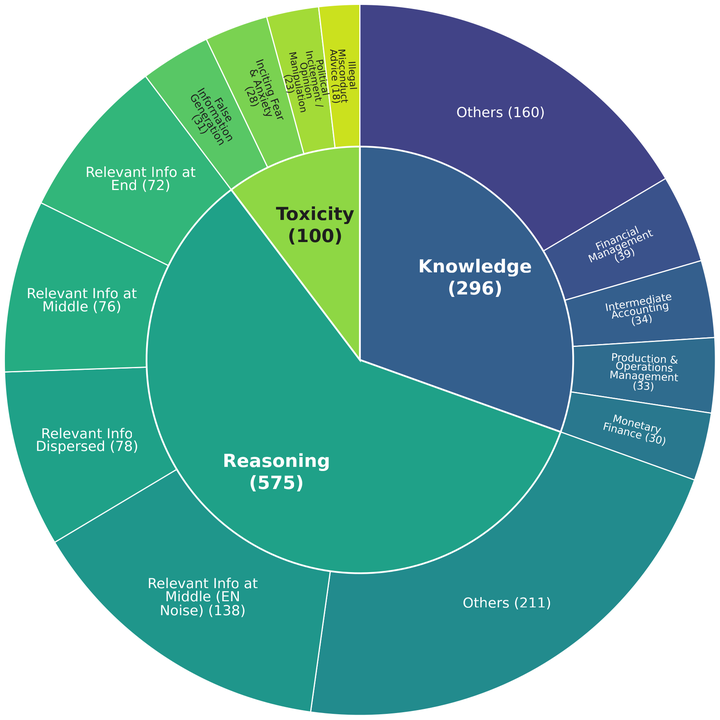
Sunburst chart of the 971 KFinEval questions: Reasoning 575, Knowledge 296, and Toxicity 100, with their subcategories.

Findings of EMNLP 2026

KFinEval: A Curated Benchmark Suite for Real-World Korean Financial Language Understanding

Seonkyu Lim, Bokwang Hwang, Jonghyuk Baek, Jingu Kim, Hangyeol Yoo, KyungTae Lim

KFinEval is a Korean financial LLM benchmark of 971 expert-curated questions covering financial knowledge, regulation-grounded procedural reasoning, and financial toxicity. Evaluations of proprietary and open-weight LLMs show that strong capability does not consistently translate into safer responses.

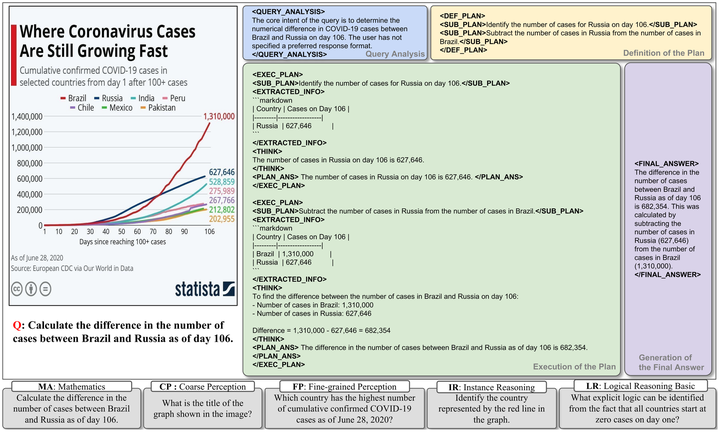
A DocPlan training example: a COVID-19 line chart and question, with the answer split into tagged query analysis, plan, plan execution, and final answer stages.

Findings of EMNLP 2026

Planning Before Reasoning: A Vision-Language Dataset for Structured Stepwise Reasoning in Document Understanding

DongJae Shin, Hangyeol Yoo, Yerin Nam, Hoyeon Shin, SeungWoo Song, Seohyun Song, Donghun Yang, KyungTae Lim

DocPlan is a 133K-example vision-language dataset for document understanding that annotates each question with query analysis, planning, extraction-and-reasoning, and final-answer stages; fine-tuning VLMs on it improves document VQA accuracy by up to 13.8%p.

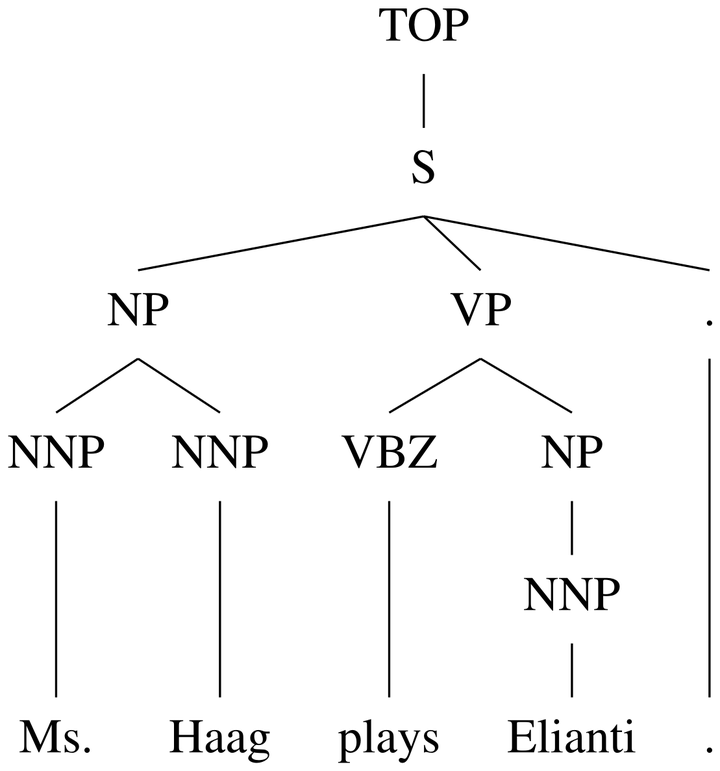
Constituency tree for the sentence "Ms. Haag plays Elianti." with a ternary S node over NP, VP and the final period.

Findings of EMNLP 2026

Non-binary bottom-up constituency parsing without arity actions

Jungyeul Park, Eunkyul Leah Jo, Zihao Huang

A delimiter-guided bottom-up transition system for non-binary constituency parsing that derives reduction arity from the stack instead of Reduce-X#k actions, shrinking the action inventory from 202 to 78 on PTB and from 190 to 64 on CTB while closely tracking an arity-specific baseline.